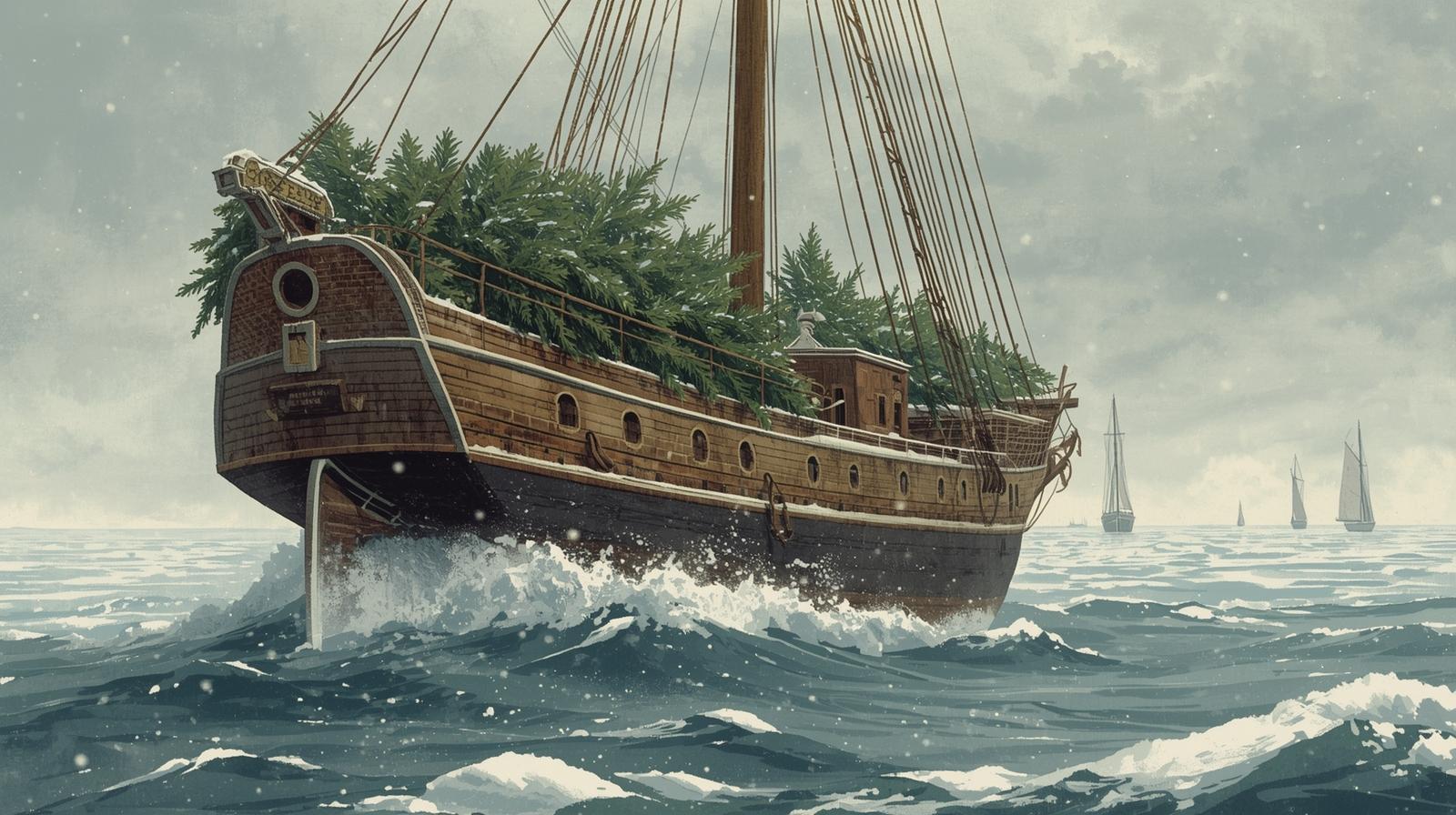
The Story of the Rouse Simmons, Chicago’s Christmas Ship
Published on December 4, 2025
If you’re visiting Navy Pier, take eATLAS’ free Adventure, a scavenger hunt that visits 10 spots that show off the diversity of experiences that can be had at the Pier.
By Dave Lifton (@daveeatschicago)
On Dec. 7th, 2025, the U.S. Coast Guard Cutter Mackinaw will make its 26th annual trip to Navy Pier to deliver Christmas trees to families in need. The Dedication Ceremony will take place at 10 a.m. at the Lake Stage at Polk Bros Park, with tours of the ship given from 1:30 – 4:00 p.m.
In Chicago’s early days, lumber was a major industry, with the forests of Wisconsin and Michigan’s Upper Peninsula providing ample material needed to build the growing city, or sent further inland via the Chicago River. This included brothers Herman and August Schuenemann, who, like many other captains, spent the last few weeks of the fall bringing Christmas trees to their hometown of Chicago before the weather made the lake too treacherous to navigate. They’d set up on a dock on the river at Clark St. and Water St. (now Wacker Dr.) and sell directly to consumers. Herman even earned the nickname “Captain Santa” because he would string Christmas lights along the ship, sell wreaths and other holiday decor, and donate trees to churches and poor families.
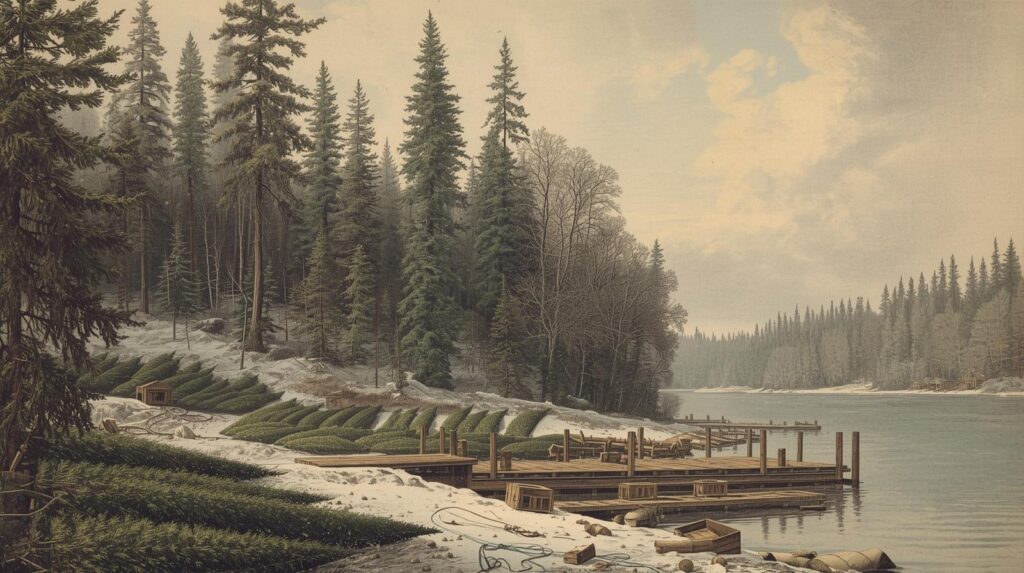
But tragedy struck the Schuenemanns in November 1898 when, en route to Chicago, August’s ship, the S. Thal, sunk off Glencoe, Ill., killing everyone aboard. Herman continued, commanding schooners with names like the George Wrenn, Bertha Barnes, and Mary Collins.
In 1910, Herman purchased a ⅛ share of the Rouse Simmons, a three-mast, 205-ton, 124’ schooner built in 1868 in Milwaukee and named for a prominent Kenosha, Wisc., businessman whose brother, Zalmon, founded Simmons Mattresses. It was built by Michigan lumber baron Charles H. Hackley specifically for the purpose of transporting wood to all points along the lake. But after 42 years of service, it was no longer in peak condition.
On Nov. 22nd, 1912, Herman Schuenemann and the Rouse Simmons left its dock in Thompson, Mich., with somewhere between 3,000 and 5,000 evergreens on board. He had also invited several Chicago-based lumberjacks so that they could be with their families for the holidays, bringing the number of crew and passengers to about 16.
Even before the ship departed, the weather conditions were getting worse. Still, Schuenemann had virtually no alternative but to make his journey. At 2:50 the next afternoon, with gale force winds coming from the northwest, a spotter at the Life-Saving Station in Kewaunee, Wisc., noticed a ship about five or six miles from shore flying a distress flag.
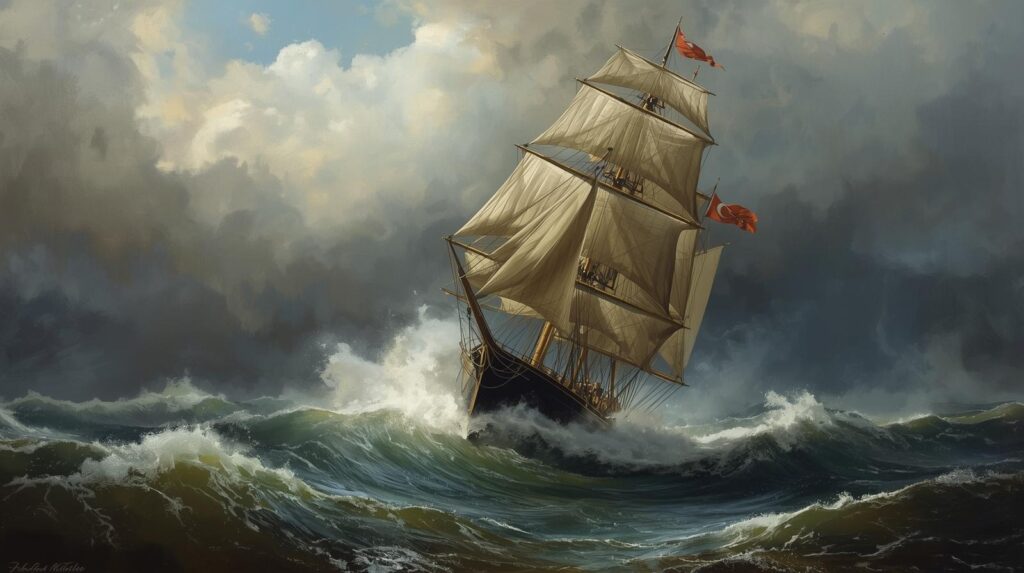
Unfortunately, the station’s lifeboat was already out on the lake, and the station’s captain telephoned his counterpart at the next station to the south, at Two Rivers 25 miles away, that the Rouse Simmons was in serious trouble.
By the time the Two Rivers lifeboat made it to the spot where the Rouse Simmons should have been, the schooner had already sunk, six miles northeast of Rawley Point – a few miles north of Two Rivers – 172 feet below the surface of Lake Michigan. It’s possible that the lifeboat circled the area above the boat during its search.
Within weeks, Christmas trees started washing up on shore, which were subsequently sold to help the families of the crew. Then, in 1923, Schuenemann’s wallet, preserved in a waterproof oilskin, was caught by a fisherman and returned to his widow, Barbara, and their daughters. But the Rouse Simmons remained undiscovered until October 1971, nearly 59 years later, when Gordon Kent Bellrichard found it while scuba diving in search of a different ship. Many trees were still secured in the schooner’s hold, with the needles fully intact.
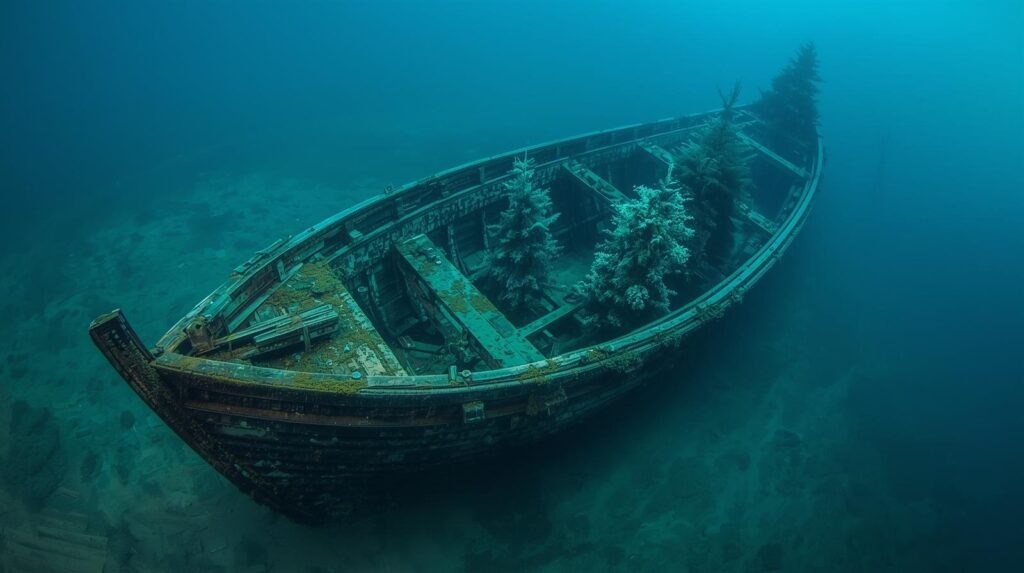
The Rouse Simmons’ anchor is now on display at the entrance to the Milwaukee Yacht Club, and the wheel and other artifacts can be seen at the Rogers Street Fishing Village and Great Lakes Coast Guard Museum in Two Rivers.
Studying the wreckage turned up a few clues as to what happened that fateful day. For starters, the port anchor had been deployed, suggesting that Schuenemann had tried to steady the ship rather than continue on. Second, the large amount of trees, believed to have been piled eight feet high on the deck, destabilized the Rouse Simmons. But ultimately, it was the combination of the weather and the age of the ship, which likely would have caused the tragedy regardless of the specifics.
In the years following her husband’s death, Barbara Schuenemann continued selling Christmas trees. At first, she was having them brought by schooner, a practice which stopped around 1920. After that, they were shipped by train and sold from a docked ship until her passing in 1933. An evergreen tree is on their shared gravestone at Acacia Park Cemetery in Norridge.

The Adventure starts when you say it does.
All eATLAS Adventures are designed and built by experienced eATLAS Whoa!Guides. They're always on. Always entertaining. And always ready to go.
Check out our Adventures!