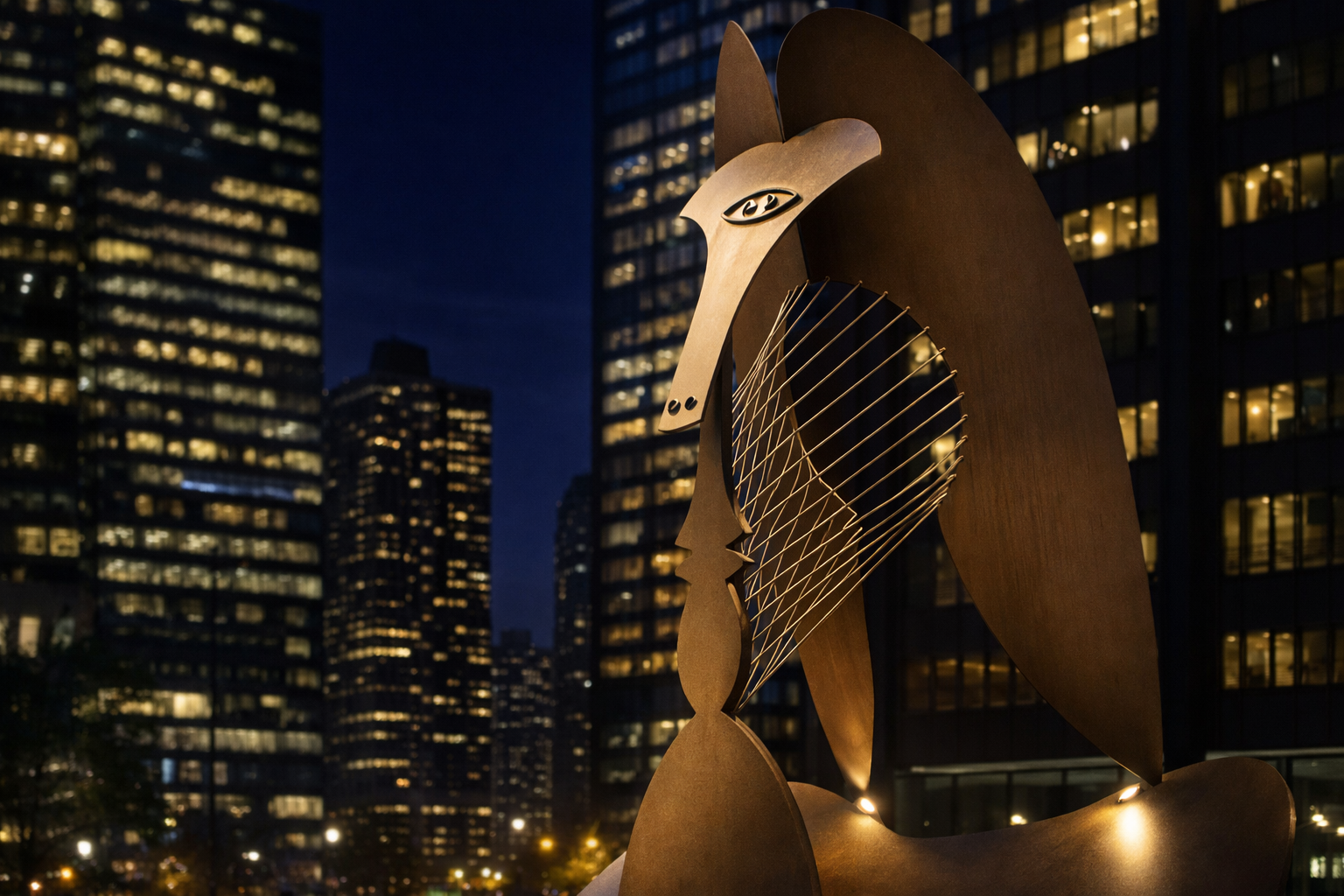
The Story of Chicago’s Picasso Sculpture
Published on January 1, 2026
eATLAS’ free Sculpture Art in the Loop Adventure visits Chicago’s Picasso and many other pieces of public art in the heart of downtown.
By Dave Lifton (@daveeatschicago)
In the early ‘60s, during the planning of a new civic center in the Loop, it was determined that a sculpture should be placed in the adjacent plaza. As befitting a city that has long followed Daniel Burnham’s ethos of “Make no little plans”, the team of architects from three prestigious firms decided that they should approach Pablo Picasso.
Convincing Mayor Richard J Daley was easy. William Hartmann of Skidmore, Owings, and Merrill told the mayor that his city deserved nothing but the world’s greatest living artist.
Getting Picasso—who’d never been in America, no less Chicago—on board, however, was a tougher task. Through Sir Roland Penrose, a biographer and friend of Picasso, Hartmann was granted an audience at Picasso’s house on the French Riviera, where he pitched the 82-year-old on the project and showed him the renderings of the Civic Center. But Picasso was indecisive. Hartmann continued to court the artist like a potential lover. He made several more visits, each time bearing gifts, including a poem written by a colleague, Sioux headdress and apparel from local sports teams.
Whether it was learning that his late friend Ernest Hemingway was born in Chicago (well, Oak Park), the idea of having his work displayed in public, or the fact that the Art Institute of Chicago had been the first American museum to display his work—the 1913 Armory Show displayed seven of his paintings—Picasso agreed. He even rejected the $100,000 Hartmann offered him, saying that his work was his “gift to the people of Chicago.”
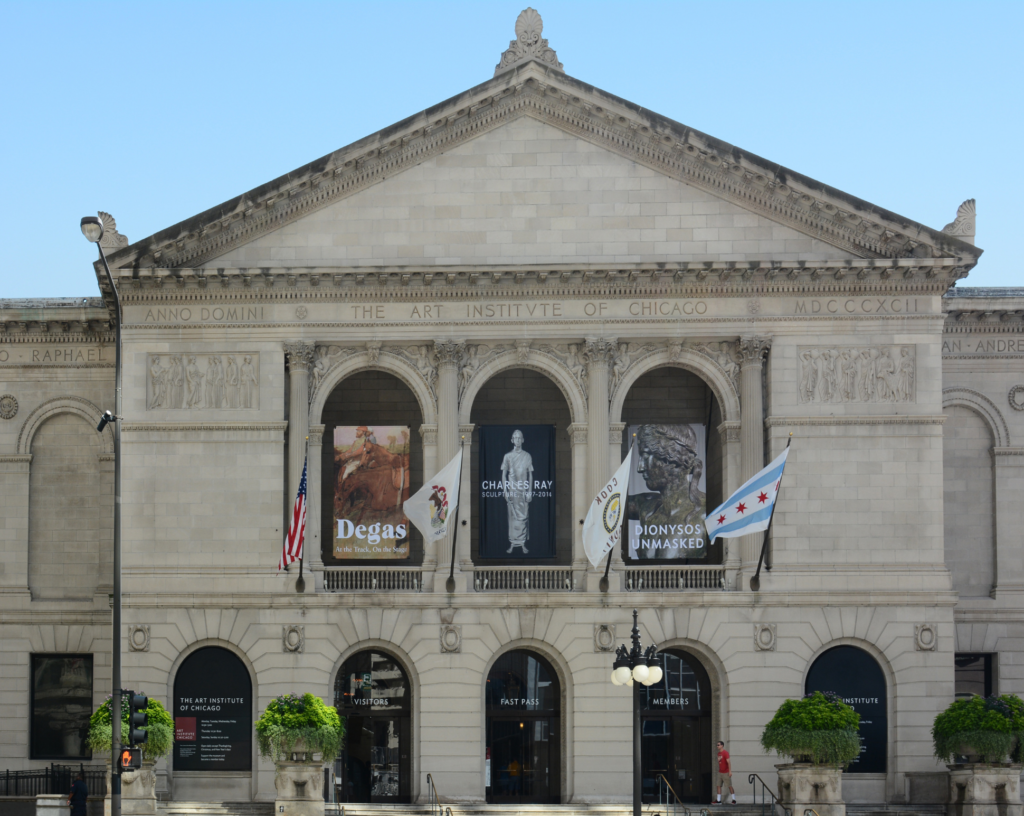
In 1964, Picasso created a 42-inch maquette (now on display at the Art Institute) and sent it to the city. The same material used for the Civic Center—Cor-Ten steel, which changes to a rust-like color as it is exposed to the elements over time—was chosen for the sculpture. The American Bridge division of U.S. Steel in Gary, Ind., fabricated the steel, and had to come up with new techniques due to the size of the panels. Three local charitable foundations—the Field Foundation of Illinois, Woods Charitable Fund, and Chauncey and Marion Deering McCormick Foundation—picked up the bulk of the $352,000 tab.
On May 25th, 1967, ground was broken on the plaza, and the process of assembling the sculpture begun under the cover of a temporary structure. Three weeks later, Aug. 15th, came the unveiling, which featured Seiji Ozawa conducting the Chicago Symphony Orchestra. Perhaps anticipating a negative reaction, Daley said, “We dedicate this celebrated work this morning with the belief that what is strange to us today will be familiar tomorrow.” Gwendolyn Brooks read a poem she penned that echoed the mayor’s sentiments. “Does man love Art? Man visits Art, but squirms,” it began. “Art hurts. Art urges voyages—and it is easier to stay at home, the nice beer ready.”
In 2022, home movie footage surfaced of the moment that the complete sculpture was revealed.
The crowd was underwhelmed. Details of the piece had already circulated, and one man brought a sign that called it a “Colossal Boo-Boo — A Creative Evacuation of Emotional Debris.” Some were upset that it was created by Picasso, an avowed Communist. John Hoellen, a North Side alderman, wanted to replace it with one of Cubs legend Ernie Banks (Daley, who grew up in the shadow of Comiskey Park, would never allow it anyway).
The main issue, though, was that nobody could figure out what it was. For centuries, public sculptures were monuments to statesmen, war heroes, or nobility. An abstract, ambiguous figure, borne out of metal, was not the norm. It didn’t help that Picasso didn’t even name it.
He did, however, suggest that his Afghan hound, Kabul, was the inspiration. But others have noted that some of his representations of women from 1962 bear more than a passing resemblance to the sculpture.
The public remained confused. “If it’s a bird or an animal, they ought to put it in the zoo,” Col. Jack Reilly, commissioner of special events, said. “If it’s art, they ought to put it in the Art Institute.” Legendary columnist Mike Royko thought it was a perfect representation of Chicago, but not for its beauty. He looked at its cold eyes and saw the city’s slumlords, corrupt politicians, and mobsters.
The mayor, the ultimate arbiter, said it looked like the “wings of justice,” and it remained.
The Civic Center and plaza were named after Mayor Daley in the immediate aftermath of his 1976 death. Daley’s words were prophetic, as the Picasso has become a symbol of the city, paving the way for more public art from famous artists. Over the next 15 years, works by Alexander Calder, Marc Chagall, and Joan Miró would beautify Chicago’s public places, paving the way for Anish Kapoor’s Cloud Gate (“The Bean”) in Millennium Park.
It’s also become a part of Chicagoans’ everyday lives. Children slide down it regularly, people eat lunch while sitting on its base, and it serves as a picturesque backdrop for the many events that are held in Daley Plaza. And newcomers still regularly want to know what it is, to which there is only one true answer.
“It’s a Picasso.”
The author finds that the majority of guests on his architecture tours who see the Picasso think that it looks like some form of primate.

The Adventure starts when you say it does.
All eATLAS Adventures are designed and built by experienced eATLAS Whoa!Guides. They're always on. Always entertaining. And always ready to go.
Check out our Adventures!