The Chicago Cultural Center: The Windy City’s Ultimate Hidden Gem
Published on February 19, 2026
The Chicago Cultural Center features in our I Love The 80s Movie Tour Scavenger Hunt and Art, Architecture & History, Oh My! Adventure.
By Dave Lifton (@daveeatschicago)
For the first 35 years of its existence, Chicago didn’t have a proper public library, only a few private collections. But in the aftermath of the Great Chicago Fire of 1871, a Brit named A.H. Burgess began a campaign to donate books to the city “as a mark of sympathy now, and a keepsake and a token of true brotherly kindness forever.”
The 8,000 volumes Chicago received included copies signed by such notables as Queen Victoria, Charles Darwin, Alfred Lord Tennyson, and John Stuart Mill. Within a few months of arriving, the Chicago Public Library was established.
But there was a problem: The collection had no permanent home. Originally housed in a disused water tank, the library continued to grow to 120,000 volumes by 1876, and the city found space where it could. In 1892, the site for the library had been chosen, an undeveloped lot on Michigan Ave. between Randolph and Washington Streets.
Shepley, Rutan & Coolidge, the same firm that designed the Art Institute of Chicago, was hired as the architects, and they chose a neoclassical approach for the five-story library. Opened to the public on Oct. 11th, 1897, the $2 million U-shaped building lived up to its billing as “The People’s Palace,” welcoming guests with a muted limestone exterior replete with a grand Roman arch at the south entrance (Washington St.) and Doric columns and carved mahogany doors from the north (Randolph St.).
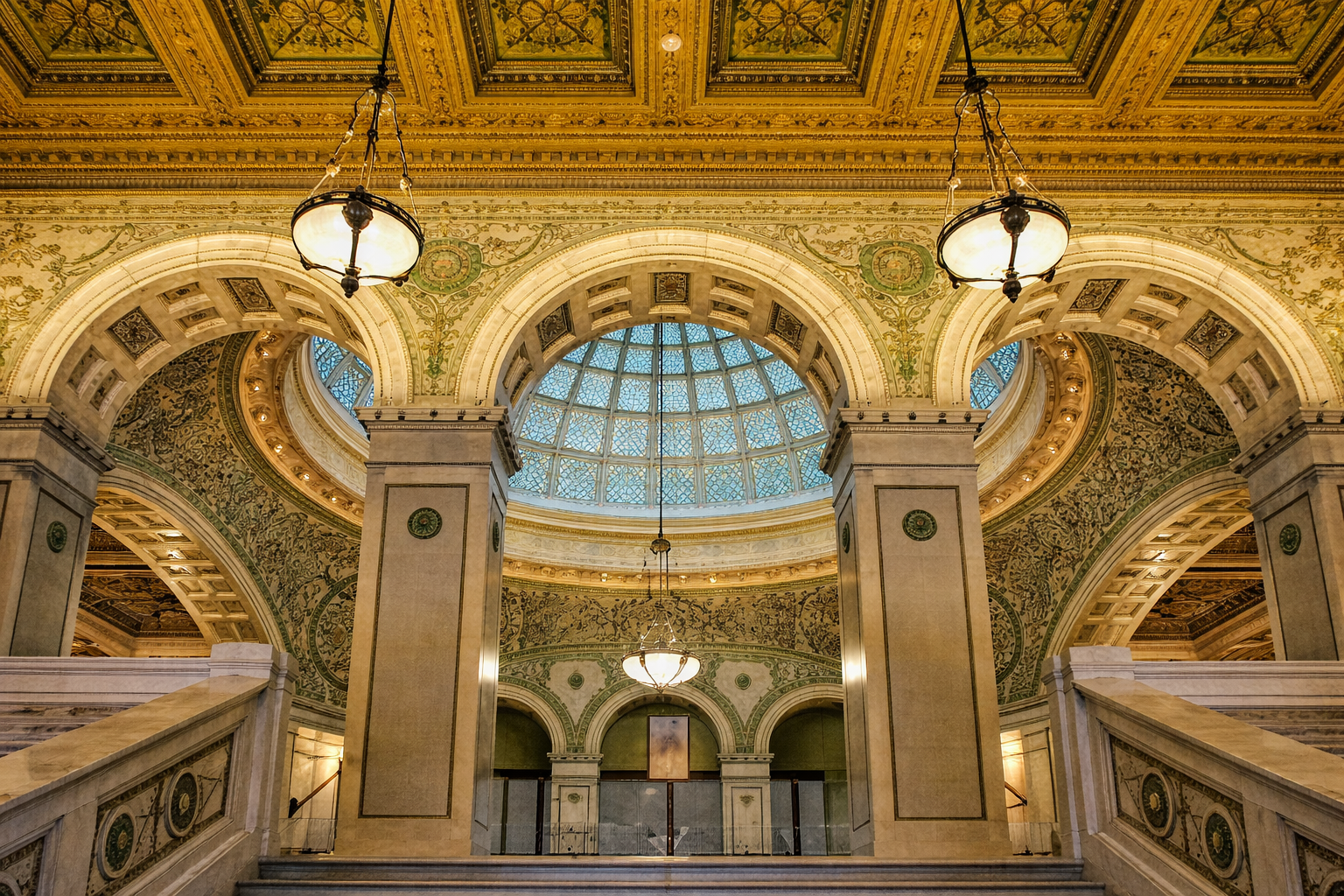
The interior proved even more dazzling. Inside the Washington St. entrance, mosaics with the names of Greek, Roman, and American writers are overhead, and a massive staircase made of Carrara marble—the kind preferred by Michelangelo—leads up to the waiting room, which features intricate, shimmering mosaic work with the names of European authors, quotes in 11 languages about the importance of knowledge, mother-of-pearl inlays on more Carrara marble, and its centerpiece, a magnificent stained-glass dome.
The entire hall was built by Tiffany Studios, and the dome is believed to be its largest. It’s 38 feet in diameter and contains 30,000 pieces of glass. The design is based on fish scales, with the signs of the zodiac at the top. Perhaps its greatest feature is its most subtle; the glass changes shades with each level, becoming progressively darker as it goes higher.
The hall even served as the opera house in Brian De Palma’s 1987 fictionalized account of the capture of Al Capone, The Untouchables.
On the north side sits the building’s other purpose. The Grand Army of the Republic (G.A.R.), a fraternal organization for those who fought for the Union in the Civil War, owned land on the lot, and gave it to the city on the condition that the library included a meeting space for them. The G.A.R. Hall and Rotunda is highlighted by another beautiful art-glass dome (40-ft. diameter, 62,000 pieces) with depictions of Greco-Roman militarism on the walls. A trio of two-story doors lead into the hall, which features walls of green Vermont marble, 30 key Civil War battles embedded in gold, and an ornate ceiling.
But Chicago’s rapid growth meant that, even as branches emerged on the North, South, and West Sides, the downtown library was too small by the 1930s. By the end of the 1940s, both domes had suffered water damage and were covered with a concrete-and-copper shell that had electric lights to provide some illumination. Like so many historic buildings demolished in the name of progress, it seemed destined for the wrecking ball.
But preservationists stepped in to save it. They even got a boost from a surprising voice. In 1972, Eleanor “Sis” Daley, the wife of Mayor Richard J. Daley, made a rare public statement by saying, “I am for restoring and keeping all the beautiful buildings.” Mayor Daley, perhaps taking a page from Marshall Field, gave the lady what she wanted, and the library was spared. A spot on the National Register of Historic Places later that year cemented its safety.
From 1974-77, the library was transformed. The open end along Garland Court was closed to build a system of ramps to better connect the north and south wings, the waiting room was renamed Preston Bradley Hall, and it and the G.A.R. Hall and Rotunda became exhibition spaces. It still had some library functions, so it was re-christened as the Chicago Public Library Cultural Center.
After the 1991 opening of the Harold Washington Library Center in the Loop, the building now only serves a purpose as the Cultural Center, with two theaters, learning lab, dance studio, gift shop, and several art exhibition spaces (including the Sidney R. Yates Gallery, formerly the fourth floor reading room). Its twin centerpieces, Preston Bradley Hall and G.A.R. Hall & Rotunda, were extensively restored to their original grandeur, replacing the cement domes with glass skylights, in 2008 and 2022, respectively (Preston Bradley Hall also received a new carpet in 2026). Both rooms are regularly rented out for events, including weddings (for a not-insignificant fee).
On any given day, thousands of people walk past the Chicago Cultural Center without any knowledge of the treasures inside. But those who enter can explore its many spaces, uncovering new layers with each visit, making it a hidden gem in the heart of downtown.

The Adventure starts when you say it does.
All eATLAS Adventures are designed and built by experienced eATLAS Whoa!Guides. They're always on. Always entertaining. And always ready to go.
Check out our Adventures!