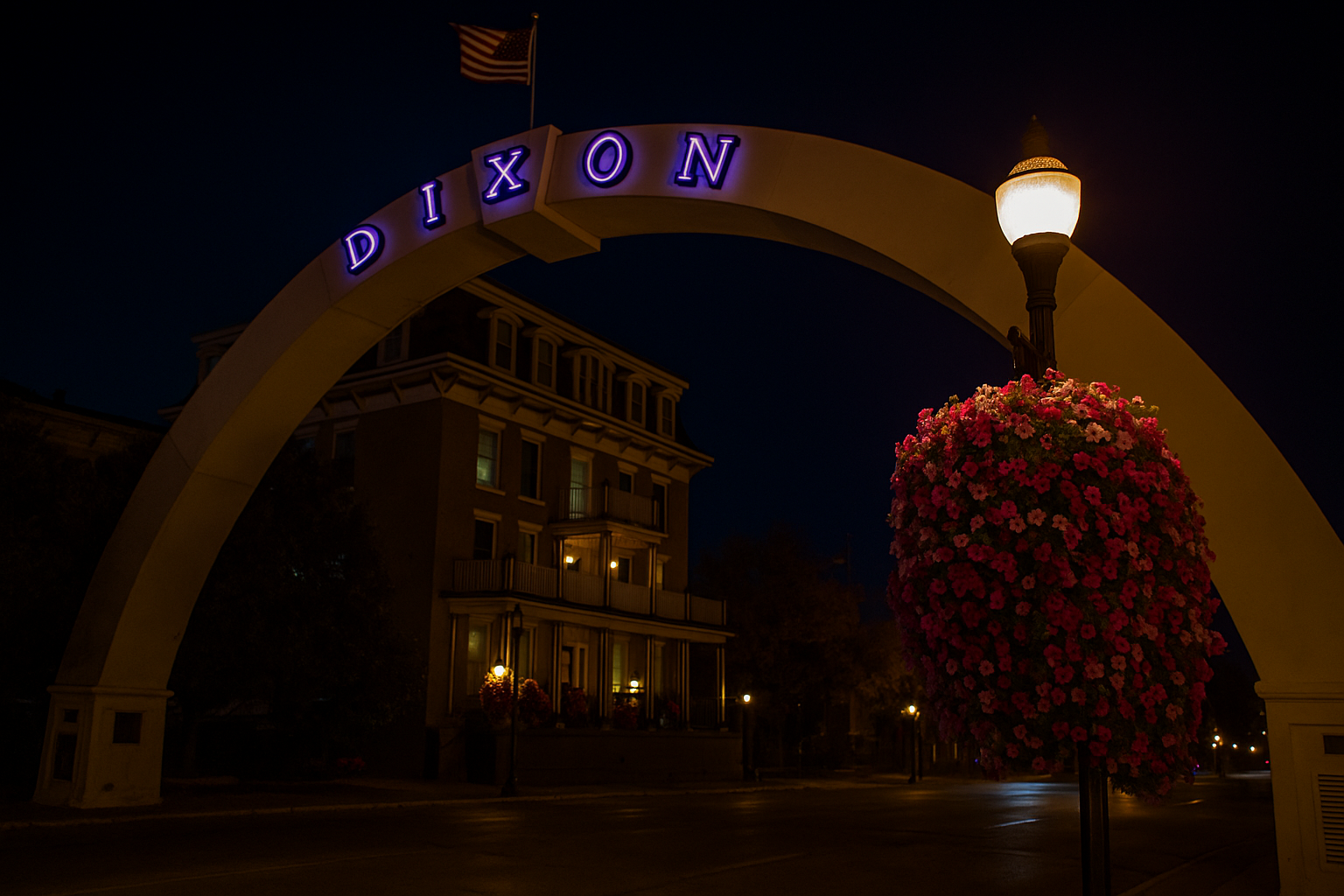
Discover Dixon, Illinois
Published on November 13, 2025
eATLAS has partnered with Downtown Dixon on a free Adventure that visits 13 stops that reflect the architecture and history of the city.
By Dave Lifton (@daveeatschicago)
In the mid-1820s, the possibility of riches to be made in the lead mines of Galena caused farmers from Southern Illinois to make their way to the Northwest part of the state. But that required crossing the powerful Rock River, and, in 1828, a man of French and Indian descent named Joseph Ogee built a house and opened a ferry service and post office a short distance southwest from a large bend in the river, calling it Ogee’s Ferry.

John Dixon was born in 1784 in Rye, N.Y. and had been one of the passengers on the 1807 inaugural ride of Robert Fulton’s first steamboat, the Clermont. In 1820, he left New York with his family, eventually landing on Fancy Creek near present-day Sherman, less than 10 miles north of Springfield. Within five years, he’d been appointed as a circuit clerk in Peoria County and also saw to the delivery of mail in Northern Illinois.
Needing money after a partnership deal for the ferry went south, Ogee sold it and his cabin to Dixon, who moved to Ogee’s Ferry with his family on April 11th, 1830. The name of the post office was soon changed to Dixon’s Ferry.
Within a few years, the area would become integral in the Black Hawk War. In 1832, a Sauk leader named Black Hawk led a band of Sauk, Fox, and Kickapoo Indians across the Mississippi River into Illinois to reclaim land that had been ceded to the U.S. government in 1804 on the grounds that the treaty was invalid, and federal troops and Illinois militia were called in to send them back to Iowa.
Dixon’s Ferry became a base for the U.S. Army and state militia during the war, with a fort built in order to protect the ferry. As a 23-year-old, Abraham Lincoln volunteered to serve in Sangamon County’s 31st Regiment in the militia, and was named the commander by his fellow soldiers. Over the course of his three-month stint, he saw no combat, but went in-and-out of Dixon’s Ferry several times in attempts to draw out the Sauk.

Lincoln would later joke, “I fought, bled, and came away … I had a good many bloody struggles with the mosquitoes.” A bronze statue of a young Lincoln in uniform, made by Leonard Crunelle and dedicated in 1930, sits in Presidents Park.

Also serving at Dixon’s Ferry during the Black Hawk War were Col. Zachary Taylor, who would become the 12th President of the United States, and Lincoln’s adversarial counterpart in the Civil War, Lt. Jefferson Davis.
On Sept. 13th, 1839, the land on which Dixon’s Ferry sat was detached from Ogle County and moved into the newly created Lee County, with Dixon named as the county seat. “Father” John Dixon, as he would become known, donated 80 acres of land to be auctioned and transferred a block to the county for the purpose of building a courthouse. Dixon was officially incorporated as a town in 1843, after a unanimous vote.
A couple of years later saw the construction of a bridge across the Rock River and a dam. The former eliminated the need for the ferry, with the latter generating enough power to facilitate the arrival of mills. Commerce improved even more in 1855 with the arrival of the Illinois Central and the Galena & Chicago Union Railroads.
At the outbreak of the Civil War, the Old Lee County Courthouse was used to recruit volunteers to serve in the 13th Illinois Regiment, and Dixon had three camps. Company A trained at Camp Dixon, which was located on the south bank of the river and was made up of Dixon residents. Camp Dement, named after Col. John Dement, was further south and housed Company B, which consisted of recruits from Sterling. Little is known about the third camp, but it’s believed to have been located near the east side of Oakwood Cemetery.
But Dixon is best known as one of the childhood hometowns of Ronald Reagan, the 40th President of the United States. His family moved from nearby Tampico to Dixon in 1920, when Reagan was nine. They settled into a Queen Anne-style house at 816 S. Hennepin Ave., which is currently owned by the Young America’s Foundation and open for public tours. Since 1982, the home has been on the National Register of Historic Places.

As a student at Dixon High School, he was on the football and track teams, a member of the Drama Club, and student body president in his senior year. From 1927 until 1933, he had a summer job as a lifeguard in Lowell Park, where he saved 77 swimmers. Reagan returned to Dixon in 1984 on the occasion of his 73rd birthday, where he said that Dixon still has, as it did in his youth, “the values and traditions that made America great.”
The author has a friend who was such an admitted history nerd in high school that, for Senior Cut Day, she went to Dixon to visit the Ronald Reagan Boyhood Home.

The Adventure starts when you say it does.
All eATLAS Adventures are designed and built by experienced eATLAS Whoa!Guides. They're always on. Always entertaining. And always ready to go.
Check out our Adventures!