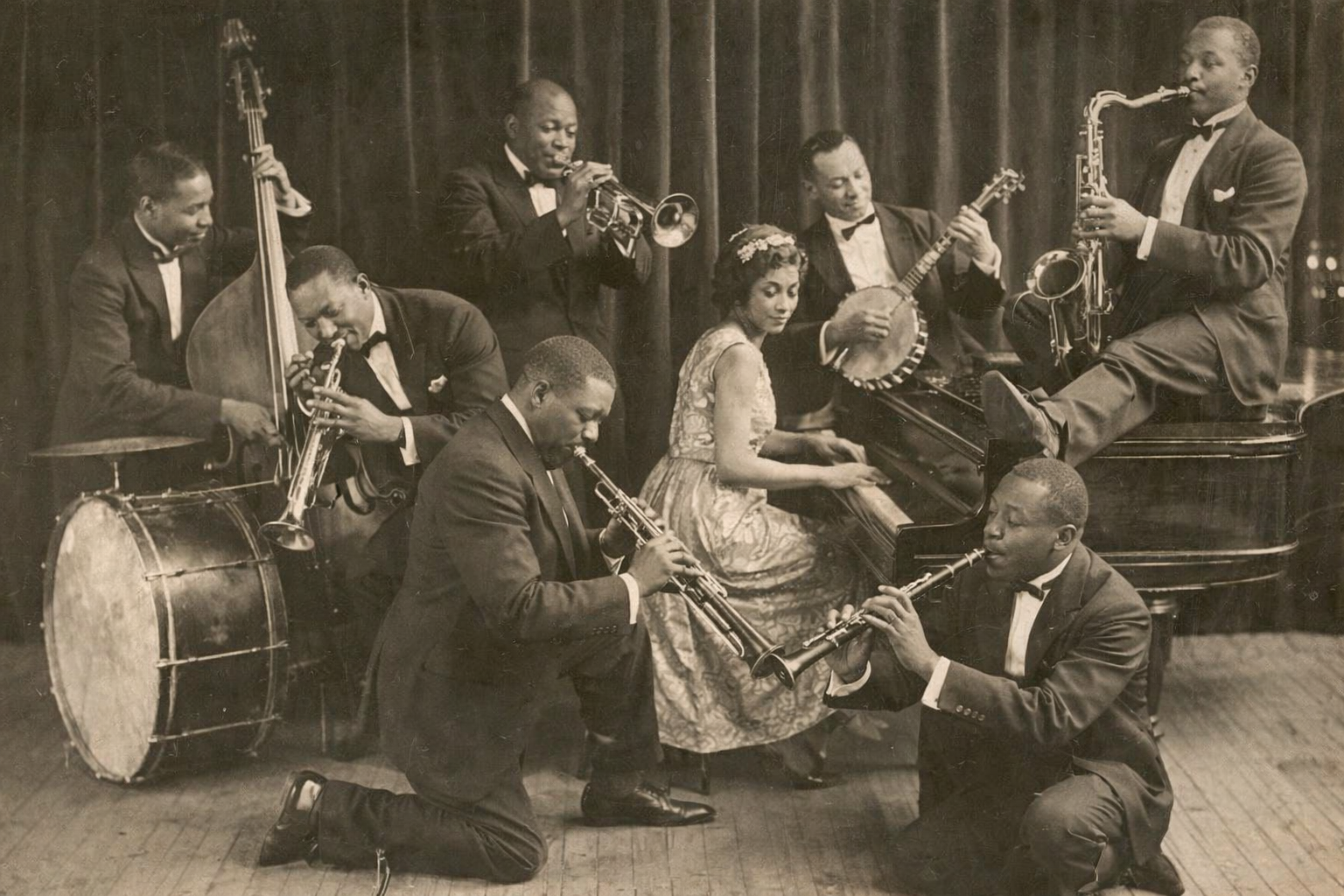
Chicago’s Legendary Jazz Musicians
Published on January 22, 2026
Jazz arrived in Chicago at the start of the Great Migration, as musicians from New Orleans made their way up north, settling in Bronzeville on the South Side. This included Sidney Bechet, Jelly Roll Morton, and Joe “King” Oliver. Louis Armstrong joined them in 1922. They were complemented by locals, such as pianists Lil Hardin, whom Armstrong would marry, and Albert Ammons.
By Dave Lifton (@daveeatschicago)
Before long, State St. in Bronzeville became known as the Stroll, the epicenter of Black nightlife in a segregated city. In Chicago, saxophones became incorporated into jazz, and the tempos sped up to match the faster pace of the city, creating the bridge between Dixieland and swing.
But Chicago’s first homegrown jazz combo of note came from the West Side. The same year Armstrong arrived, a band of students at Austin High School heard records by the New Orleans Rhythm Kings, an all-White band comprised of Chicagoans and New Orleanians, at an ice cream shop. The kids—Frank Teschemacher (alto sax), brothers Jimmy (cornet) and Dick (banjo, guitar) McPartland, Bud Freeman (tenor sax), and Jim Lanigan (piano, bass, tuba)—were already playing school dances and parties, and instantly switched to jazz. They never recorded as a group; however, each would find success as bandleaders or sidemen, and they would go down in jazz history as the Austin High Gang. They also often worked with Eddie Condon (guitar) and Muggsy Spanier (cornet), two other men who would become famous.
The Austin High Gang weren’t the only White Chicagoans turned on to jazz in the early ‘20s. By the time he was 14, clarinetist Benny Goodman was already a member of the American Federation of Musicians. At the start of the Great Depression, the 20-year-old moved to New York and became a star. He teamed up with another Chicagoan, drummer Gene Krupa, and their 1937 recording of “Sing, Sing, Sing”—propelled by Krupa’s explosive work—became the defining song of the Swing Era. Goodman also played a major role in the integration of jazz in the mid-‘30s when he brought Teddy Wilson (piano) and another Chicagoan, Lionel Hampton, (vibraphone) into his band.
But The South Side would soon start creating jazz stars. The son of Baptist minister and the church organist, pianist Nathaniel Coles dropped out of high school to focus on his budding music career. After moving to Los Angeles, he formed a trio and started calling himself Nat King Cole. In addition to his instrumental skills, Cole possessed a warm baritone that graced dozens of hits from 1942-64, including “Unforgettable,” “Route 66,” “Nature Boy,” and the holiday staple, “The Christmas Song.” In 1956, he became the first African American to host a national TV variety show.
Another singer raised in Bronzeville was Dinah Washington. Adept at jazz, ballads, and blues, Washington placed 29 songs in the R&B Top 10 chart between 1944-54, and crossed over to the pop chart starting in 1959 with “What a Diff’rence a Day Makes.” Washington was inducted into the Rock & Roll Hall of Fame in 1993 for her influence on subsequent generations of female blues and soul singers, including Etta James, Ruth Brown, and Aretha Franklin.
Cole and Washington attended Bronzeville’s DuSable High School, where the man in charge of the music department was Captain Walter Dyett. In his 35 years as an educator and bandmaster, he taught dozens of future jazz greats, including Johnny Hartman, Clifford Jordan, Gene Ammons, Milt Hinton, Richard Davis, and Eddie Harris. A school for the arts named after Dyett sits in Washington Park.
But Dyett never got to teach unquestionably the most famous jazz musician to come out of Chicago. Quincy Jones only lived in Bronzeville for the first 10 years of his life before moving to the Seattle area in 1943, but he was already starting to play piano thanks to his neighbor Lucy Jackson, whom he heard playing stride piano through the walls of his apartment. His 50+-year career as a trumpeter, arranger, composer, producer, and media mogul would see him work with Frank Sinatra, Ray Charles, Michael Jackson, Count Basie, Ella Fitzgerald, Sarah Vaughan, and countless others.
Similarly, Herbie Hancock’s career has also encompassed more than half a century. The classically trained pianist from Hyde Park split much of the 1960s between his solo work (“Cantaloupe Island,” “Watermelon Man”) and Miles Davis’ second quintet, which saw the legendary trumpeter move from hard bop to jazz fusion. In the next decade, he helped popularize jazz-funk as the leader of the Headhunters, and brought jazz concepts into hip-hop with his 1983 hit “Rockit.” He’s earned 14 Grammy Awards over the course of his career and an Oscar in 1986 for his score to Round Midnight.
The spirit of Chicago’s history as a major jazz center, from traditional to avant garde, can be heard nightly at many clubs throughout the city.

The Adventure starts when you say it does.
All eATLAS Adventures are designed and built by experienced eATLAS Whoa!Guides. They're always on. Always entertaining. And always ready to go.
Check out our Adventures!